

MiniMax M3 Inside OpenSymphony
What the Model Did Under Pressure

I ran MiniMax M3 inside OpenSymphony on two real engineering tasks. The useful signal showed up after the first draft.
MiniMax M3 kept improving under review. It read the task, changed a real repository, ran checks, absorbed automated critique, repaired tests, and left enough evidence for a maintainer to understand what happened.
That is the behavior I care about in coding agents now. A model that writes a plausible diff is table stakes. A model that can stay oriented through rework is much rarer. The loop shape matters too. MiniMax M3 converged in a setting where review was frequent, model calls were fast, repeated context was mostly cached, and tests turned critique into executable pressure.
The setup was early access to MiniMax M3 on Fireworks inside my OpenSymphony orchestration framework. OpenSymphony uses OpenHands as the execution harness and wraps it in a work-oriented control plane: automated work-item dispatch, isolated workspaces, repository policy, terminal access, file editing, automated code review, validation commands, polling for requested changes, and a durable workpad for run evidence.
MiniMax M3 was operating as the model inside an autonomous coding loop.
The Shape of the Work
I used the model on two kinds of tasks.
The first was a compiler-like planning task. The agent had to take structured planning artifacts and turn them into a hierarchy that downstream systems could publish and validate. It needed to preserve metadata, enforce a taxonomy, produce machine-readable YAML, and report actionable diagnostics when the source plan was underspecified or inconsistent.
The second was a desktop app verification task. The agent had to verify that the desktop shell mounted the real shared app surface, strengthen smoke tests, repair brittle assertions, and prove that the tests would fail if the app regressed to a stub.
Those two tasks were useful because they stress different parts of a coding model.
The planning compiler asked for semantic precision. The model had to respect distinctions between milestones, issues, sub-issues, dependencies, source files, validation messages, and publish receipts. This is the kind of work where a shallow model can write Rust that compiles while quietly corrupting the contract.
The desktop task asked for operational judgment. The model had to read an existing app shell, identify where regression tests were thin, and add safeguards while keeping runtime churn contained.
The two tasks exposed different strengths.
The Model Treated Review as Specification
The planning task started with a solid architectural shape. MiniMax M3 created typed domain objects, separated compilation from validation, emitted structured output, and covered the expected path with tests. It understood that this layer should be a pure projection and validation layer, with side effects kept outside the component.
The first version still had issues. Some names implied the wrong semantics. A few diagnostics could be duplicated. Some consistency checks were one-directional when they needed to compare both sides of a manifest. One test assertion passed while proving too little. A helper name promised behavior beyond the implementation.
That is normal agent code. The more important question is what happens after those problems are named.
MiniMax M3’s response pattern was strong. Review became additional specification. When review found duplicate diagnostics, the model added regression coverage. When review pushed on weak manifest checks, the model expanded the consistency model. When review criticized assertion quality, the model improved the failure output so the next failure would be easier to inspect.
That matters because many coding agents are good at producing volume and weaker at converging. They patch the visible symptom, rerun the obvious command, and leave the deeper contract unchanged. MiniMax M3 looked better than that. It seemed to understand that the review comments were pointing at invariants.
In a planning compiler, invariants are the whole game.
It Had Good Semantic Grip, With Familiar First-Pass Weaknesses
The strongest behavior on the compiler task was the model’s grip on domain shape. It kept the output structured. It preserved source metadata. It modeled validation separately from compiled output. It treated dependency information as deterministic data. It also kept downstream publication concerns visible and outside execution.
That is a good sign for agentic coding. Real repository work often fails because the model loses track of the contract between layers. MiniMax M3 mostly kept the layer boundary intact.
The weaknesses were also instructive.
The model’s first pass sometimes chose names that only roughly matched the data. It generated validation behavior that was directionally right and loose. It wrote some tests that checked a condition while failing to prove the behavior a human reviewer actually cared about.
That is semantic looseness: code that compiles while encoding a slightly wrong meaning.
This is where the harness matters. If I had asked for the compiler in a one-shot chat and accepted the output, I would have shipped subtle contract problems. Inside OpenSymphony, the model had review pressure, runnable tests, and a persistent work surface. That environment exposed the looseness and gave the model room to correct it.
My read: MiniMax M3 has enough semantic understanding to build the right shape, and it benefits from explicit review on naming, duplicate states, diagnostic contracts, and end-to-end parity checks. That is a workable profile. I can design a workflow around it.
It Used Tests as Evidence, Not Decoration
The desktop task showed a different trait: test pragmatism.
A weak smoke test is easy to write. It imports the app, renders something, checks for a live process, and calls the result coverage. That kind of test is mostly decorative. It gives a green check while missing the failure mode that actually matters.
MiniMax M3 did something better. It strengthened tests around the app shell’s real mount path, the visible desktop surface, navigation through the shared UI, profile controls, fallback data, and route contracts. Then it performed a negative proof: temporarily break the marker that distinguishes the real app from the stub, confirm that the smoke tests fail, and revert the break.
That small move was better evidence than another passing test count. The model checked the test’s protective value.
The model also responded well when review found test-quality flaws. A timeout helper that returned silently became an explicit failure. Async cleanup was awaited. A brittle parser used by a contract test became resilient to ordinary source syntax.
Again, the pattern was the interesting part. MiniMax M3 made tests part of the response to critique.
It Was Fast Enough for the Outer Loop to Matter
The logged runs were token-heavy. The larger task accumulated tens of millions of input and cache-read tokens. The smaller task still used millions. That is the reality of persistent agent work in a nontrivial repository: the model sees repeated policy, task, file, review, and validation context across many turns.
The latency profile was the pleasant surprise. Median model-call latency sat at about 3.05 seconds on the larger run and 2.38 seconds on the smaller one. The p95s were still low enough for an automated agent loop: about 6.28 seconds and 4.25 seconds. In practice, the model was fast enough that the bottleneck moved outward to tests, type checks, automated code review, polling, and validation.
Prompt caching also mattered. In the larger run, over 20 million of roughly 22 million logged input tokens were cache-read tokens. In the smaller run, over 5.1 million of roughly 5.4 million were cache-read. A persistent agent needs reuse when it sees the same repository rules, task context, and prior state across many turns. The model and provider path were fast enough that OpenSymphony’s reuse pattern felt justified.
Review Iterations Exposed the Model
The automated review pattern matters as much as the model call.
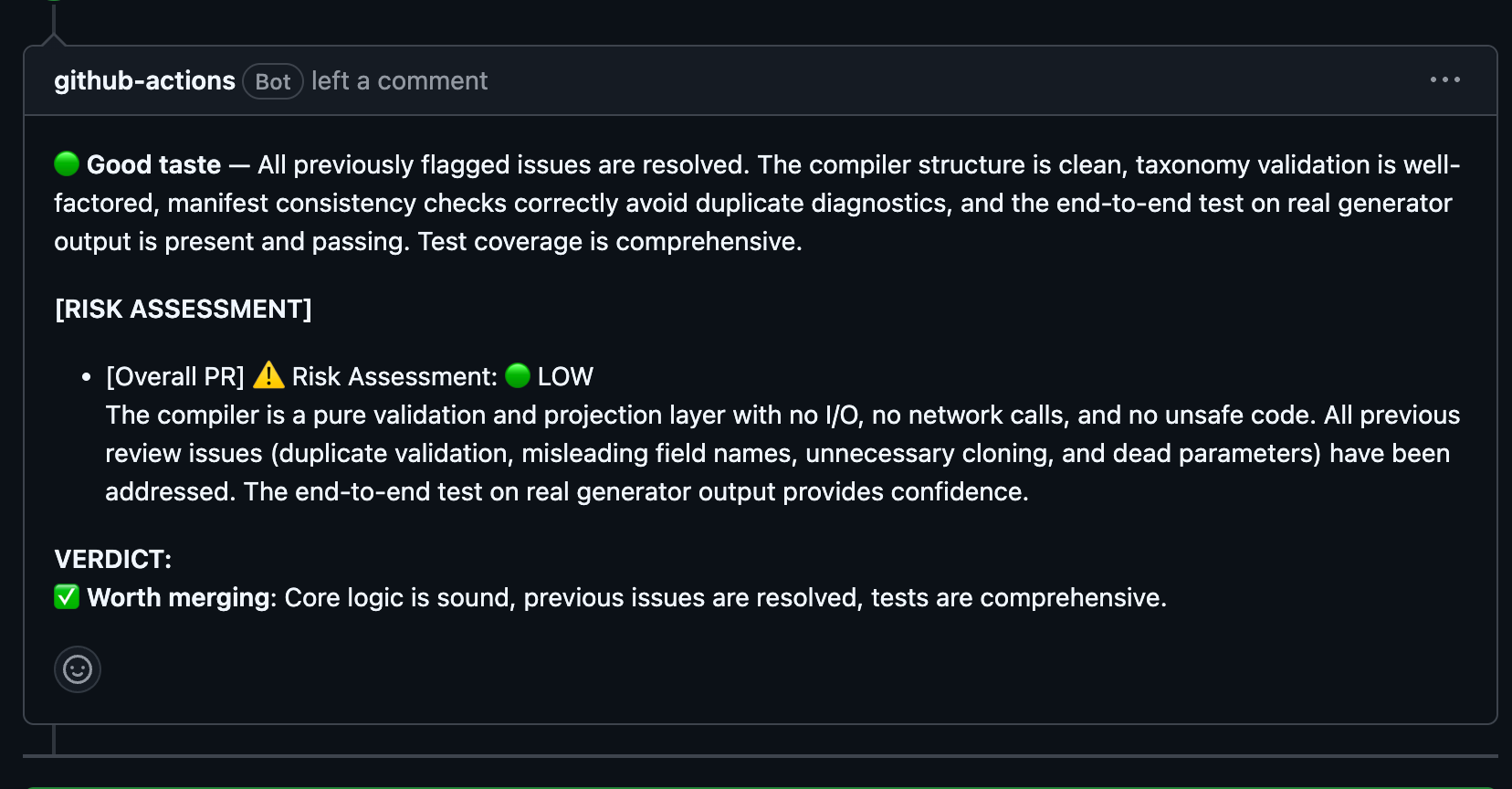
Each submitted change was a proposed completion. The agent opened a reviewable change because it believed the work was ready. Automated review then found more to fix. The next review pass shifted scope: first concrete defects, then narrower diagnostic semantics, ordering, manifest consistency, assertion quality, and failure output.
Those successive proposed-completion attempts revealed the model’s behavior. MiniMax M3 often turned reviewer comments into regression tests, stricter consistency checks, clearer diagnostics, and better failure messages. The fixes reached the contract around the code: tests, consistency checks, diagnostics, and failure behavior.
Speed matters here in plain unit-time terms. The same asynchronous workflow can do more useful work when model calls are cheap and quick: more tool calls, more test runs, more review-response attempts, and more evidence updates. Cache reuse has the same effect on cost. It keeps repeated repository context from making every rework cycle feel like a fresh full-context run.
That is the claim I would make carefully. MiniMax M3 showed convergence across automated review iterations. The loop made those iterations cheap enough to observe.
What the Model Seemed Good At
MiniMax M3 looked strongest in five areas.
First, it maintained task orientation across rework. The final changes still matched the task shape and avoided drift into local cleanup.
Second, it handled mixed-language repository work. The runs touched Rust, TypeScript, YAML, frontend tests, desktop wiring, and documentation. The model moved between those surfaces and kept task state intact.
Third, it responded to review with actual code-quality improvement. The review loop made the output better, and the model added tests that made the improvement harder to lose.
Fourth, it wrote useful evidence. The workpad updates captured plan state, validation results, review responses, and operational notes. That record is one of the main differences between a coding demo and an inspectable engineering process.
Fifth, it showed decent judgment about risk. On the desktop task, it focused on verification and regression protection and left working runtime paths alone. That restraint matters. A coding agent that changes too much can be more expensive than one that writes too little.
Where I Would Still Put Guardrails
Contract-heavy code still needs review.
The model’s first pass can be structurally right while still missing semantic details: duplicate diagnostics, field names that imply the wrong thing, weak assertions, incomplete consistency checks, brittle helpers. Those issues cause maintenance pain later because they often fail quietly.
I would also require end-to-end tests earlier. The model eventually added stronger coverage. The workflow should ask for it up front when the task crosses a boundary between planning artifacts and published output, or between UI mount behavior and smoke tests.
I would give the model a pre-review checklist with boring, specific prompts:
Are any diagnostic messages duplicated?
Do field names describe the stored value exactly?
Does every test fail if the intended behavior breaks?
Are consistency checks bidirectional where they need to be?
Did any helper name promise behavior beyond the implementation?
That checklist is ordinary engineering hygiene. MiniMax M3 seems capable of acting on that kind of constraint when the harness makes it explicit.
My Read
MiniMax M3 looks like a strong agent model when embedded in a disciplined engineering loop.
Its best observed trait was convergence inside that loop. It could start with a plausible implementation, take review seriously, repair semantic gaps, improve tests, and keep moving while preserving the task.
That makes it a good fit for OpenSymphony’s operating model. OpenSymphony assumes that long-horizon agent work needs a harness, a work item, a persistent workspace, review pressure, validation gates, and a durable evidence trail. MiniMax M3 behaved well inside that structure.
The caution is equally clear. Treat it as one component in a supervised system. Give it explicit acceptance criteria. Put review in the loop early and often. Ask for tests that can fail for the right reason. Keep latency and cost visible. Preserve run evidence. Make the harness do the boring supervisory work.
In that setting, MiniMax M3 showed the behavior I want from a coding model: fast iteration, stable task orientation, review responsiveness, test discipline, and enough judgment to improve the engineering surface.