

Any Chatbot Can Become a Living Expert
I transformed a template-based chatbot into a visual, voice-enabled expert with complete control and scalability.

Want the quickest read?
Hey there! 👋
Are you a teacher looking for a spark of AI magic - but cringe at chatting with a faceless bot? Maybe you’re a student who wants a real coach, not another cold, click-through tool. Or perhaps you’re just curious about something - say, the latest gems from our AI Center of Excellence - but don’t feel like pasting walls of text into ChatGPT.
Good news: I’ve got a smart and focused voice-and-video avatar (demo one has my face speaking - so open the video at your discretion 😂) you can spin up in under a minute.
Read this article to find out what decisions I made and how this app is different from the others out there.
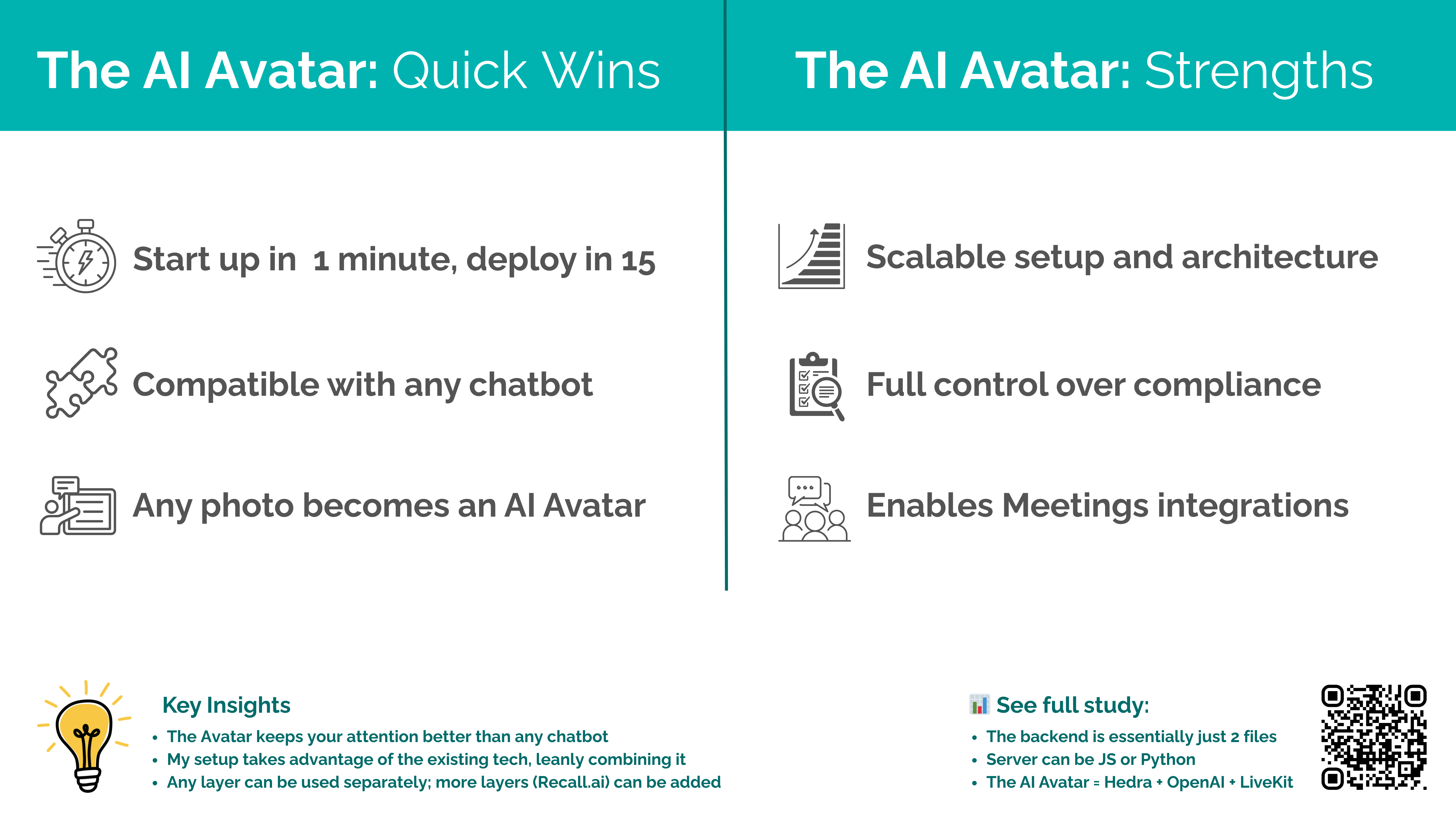
Executive Summary
I transformed a simple template-based chatbot into a visual, voice-enabled expert with complete control and scalability. Matter of fact, I made it very easy to convert any chatbot you have into your own virtual coach/expert who can assist or sit quietly.
The chatbot revolution gave us templates - anyone could spin up a customer service bot in minutes using platforms like Chatfuel or ManyChat. But these bots are trapped in text boxes.
The breakthrough isn't chasing the latest avatar technology - it's the architecture. By creating a simple two-layer system that prioritizes control and scalability over perfection, I've made video AI agents deployable in under a minute via Docker.
This isn't about building the most realistic avatar. It's about building what actually works.
Introduction
Remember when creating a chatbot meant hiring developers and spending months on custom code? Then came the templates. Suddenly, anyone could build a bot by filling in some fields and clicking "deploy." That democratization changed everything.
But we stopped halfway. Those chatbots are still text-based, still boring, still abandoned after a few interactions.
Here's what everyone missed: those same template-based chatbots can become living, breathing video agents. Not in months. Not with a development team. In minutes, using the same simple approach that made chatbots accessible to everyone.
The Missing Piece
Right now, businesses have chatbots built from templates:
Customer service bots answering FAQs
Lead generation bots qualifying prospects
Knowledge base bots explaining products
Training bots onboarding employees
They work, but they're forgettable. Users type a few questions and leave. The personality, the engagement, the human connection - it's all missing.
What I Actually Built
I didn't build another AI avatar platform chasing photorealism. I built something more practical: a two-layer system that gives any chatbot a face and voice while maintaining complete control.
The Two-Layer Architecture That Actually Scales
Layer 1: Any Generative AI Chatbot
Can be voice or text-based
Your existing logic stays untouched
Complete control over the AI brain
Layer 2: The Avatar Service
LiveKit for real-time room management
Hedra for avatar generation via LiveKit plugins
OpenAI for conversational intelligence
Here's why I chose this stack: Hedra loses to HeyGen in terms of realism (imho), and it loses to Tavus because it lets you create meeting rooms with ease. But here's the catch - with Tavus, they create and control the meetings, which can be a compliance nightmare. With HeyGen, there's less control over the actual agentic brain.
I wanted full control. That's what my system delivers.
The Control Features That Matter
I've programmed it with stop/start words - give the stop command and the avatar goes silent, listening in the background like an actual consultant would. Say the start word and it rejoins the conversation.
The entire backend? Two files (essentially). One for the AI agent, one for the avatar service. Either can be swapped for whatever's trendy next month, but the architecture remains solid.
Technical Reality: Simple Beats Perfect
Technology Stack Breakdown
Let me be clear about the technical choices:
LiveKit - the backbone for real-time communication rooms. Rock-solid WebRTC infrastructure that just works.
Hedra - while it's arguably the second-best avatar generation software, It gives us the control we need while being good enough for real conversations.
OpenAI via LiveKit plugins - Standard choice for conversational AI, integrated cleanly through LiveKit's plugin system.
Why This Architecture Wins
Whatever I build in a week - and this comes from gathering insights across Trilogy, my company - shouldn't depend on one technology and shouldn't chase the most realistic latest stuff. It should aim for scalability.
My system allows any chatbot to be combined with proven avatar generation while maintaining complete control. You control:
When the bot speaks
What it says
How it behaves
Where it runs
Non-Technical Section: Control Beats Features
The Vendor Lock-in Problem
Most avatar platforms want to own your entire stack. They create the meetings, they control the brain, they host the infrastructure. That's fine for demos. It's terrible for production.
When Tavus creates your meetings, what happens when:
You need specific compliance controls?
You want to integrate with your existing meeting infrastructure?
Their platform changes or pricing increases?
When HeyGen limits your agent customization, how do you:
Implement your specific business logic?
Ensure consistent responses across channels?
Maintain your intellectual property?
The Scalability Reality
A simple system that deploys anywhere beats a perfect system locked to one vendor. Our two-file backend can be:
Deployed on any cloud
Run on-premise for security
Modified without breaking warranties
Scaled horizontally with standard tools
Real Implementation
Local launch
Copy .env and add the keys. Run
./start-simple.sh
That's it for local. Deploy containerised as easily.
What This Enables
Compliant Customer Support: Your avatar, your infrastructure, your rules
Controlled Training Sessions: Stop/start for natural conversation flow
Secure Internal Experts: Deploy on-premise for sensitive data
Scalable Knowledge Bases: Dockerized deployment scales horizontally
The Future: Meeting Integration (If You Want It)
I'm in conversations with Recall.AI - I snuck my way into their Slack - about their latest meeting bot joining capabilities. Here's the thing - I could have built meeting integration already. But I didn't, and here's why:
The core system needs to be rock-solid first. It needs to prove that the two-layer architecture works, that the control mechanisms are valuable, that the Docker deployment is truly simple.
If this article gathers traction - if the community shows this approach resonates - I'll build part two: making this bot join meetings while maintaining the same meaningful contribution and clear control it provides when deployed locally.
Conclusion
First came chats. Then came the bots. People keep chasing the easiest ways to find and learn, but they are boring. The AI avatar will be your next:
Teacher who the students want to pay attention to
Consultant who would sit in the meetings, quietly taking notes until asked a direct question
Background expert who you can enlist with easy any moment
Many more applications
Now comes the final piece: avatar systems that prioritize control over features, scalability over perfection, and deployment over demos.
This isn't about building better AI avatars - they will come from the companies whose business it is to develop them. It's about making existing chatbots actually useful by giving them presence - on your terms, with your control, in your infrastructure.
Transform your chatbot into a visual expert with complete control. Two files, one minute deployment, zero vendor lock-in.
Brilliant read! The way AI avatars are evolving from simple digital personas to deeply personalized, intelligent assistants is truly fascinating. This feels like the beginning of a major shift in how we interact with technology. Excited to see how TrilogyAI continues to push the boundaries in this space!
Building on Huseletov's point, it's crucial to consider the learning process for AI chatbots. Just like a human expert, they need exposure to a wide range of scenarios to truly evolve and adapt.